Every Brand Sits In One Of These Four Buckets
Moving a brand through stages of growth starts with understanding the stage they are at.
Date
Category
Writer

Every brand I've ever worked with sits in one of four buckets.
Growing, but inefficient.
Growing and efficient.
Not growing and inefficient.
Not growing, but efficient.
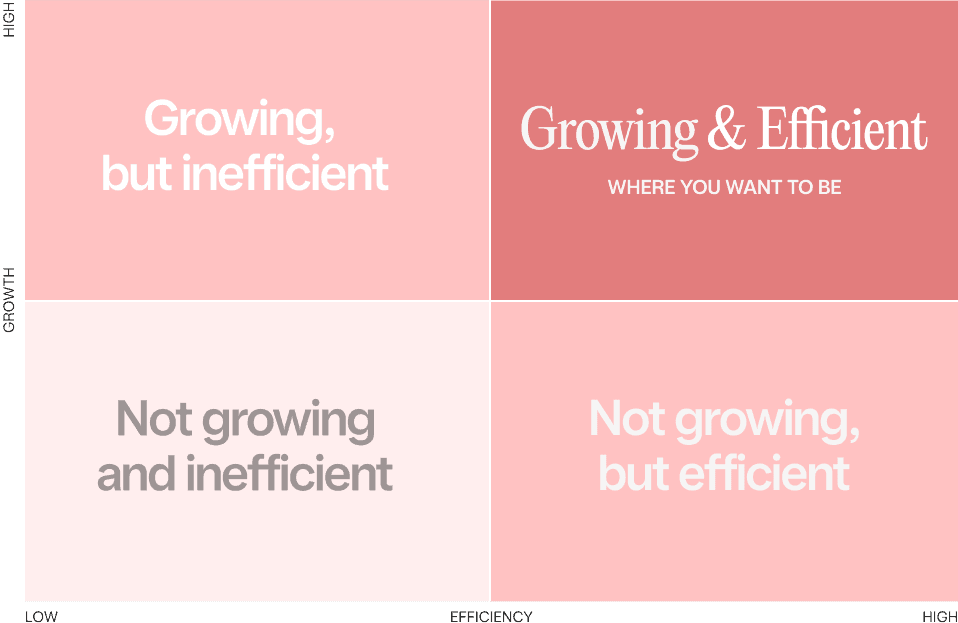
That's the full matrix. Every brand, regardless of size, category, or channel mix, lives somewhere inside it at any given moment. And where they sit changes constantly, based on market conditions, creative performance, product cycles, competitive pressure, and a dozen other factors that compound on each other in ways that aren't always obvious in real time.
Here's what makes this framework valuable: it's diagnostic. It takes what feels like a complicated, multi-variable growth problem and forces a single clarifying question: which bucket are you actually in right now? That question has to be answered before any strategic decisions get made.
Most brands skip it entirely. They react to last week's numbers, make changes based on instinct or urgency, and wonder why their growth curve looks like a heartbeat monitor instead of a compounding line. The matrix doesn't solve that. But it creates the conditions where better decisions become possible, because the conversation starts in the right place.
Let's go through each quadrant: what it looks like in practice, what the real risks are, and what the right strategic response is.
1. Growing, but Inefficient
This is the most dangerous place to be, precisely because it doesn't feel dangerous.
Revenue is moving. The team is energised. Stakeholders are happy. The instinct is to keep pushing: more spend, more creative, more campaigns. And in the short term, that instinct isn't obviously wrong.
But underneath the growth, the unit economics are quietly deteriorating.
Customer acquisition costs are climbing. Maybe slowly at first: 10%, then 15%, then suddenly you're looking at a CAC that's eating into contribution margin in ways the top-line revenue numbers are masking. The ROAS might still look acceptable, but ROAS doesn't tell you whether the customers you're acquiring are worth acquiring. Cohort LTV is often flat or declining in this phase, because growth-at-all-costs acquisition tends to pull in lower-quality customers: deal-seekers, one-time buyers, people who responded to an aggressive discount and have no intention of coming back.
In fashion and apparel specifically, this phase often shows up around big acquisition moments: a sale period, a viral product, a successful influencer push. The brand scales spend to capture the demand, and the numbers look great for 6-8 weeks. Then retention metrics come in and tell a different story.
The right response here isn't to slow down. It's to restructure.
That means auditing contribution margin by channel, not just by campaign. It means understanding which customer cohorts are actually profitable over 90 and 180 days, not just at first purchase. It means tightening spend to where it's working profitably, even if that means pulling back on channels or audiences that are generating revenue but destroying margin.
The hardest conversation in this phase is usually with founders and commercial teams who see any reduction in spend as a retreat. It isn't. It's a recalibration that makes the next phase of growth sustainable. Growth without efficiency isn't a runway. It's a ceiling you're about to hit.
2. Growing and Efficient
This is where every brand wants to be. CAC is healthy. LTV is building. Contribution margin is expanding. The machine is working.
The mistake most brands make here is treating this state as stable. It isn't. It's a window, and the job during that window is to both protect what's working and build what comes next.
On the protection side: creative fatigue is the most predictable threat, and the most consistently underestimated one. The creative that's driving your best performance right now has a shelf life. In fashion and apparel, that shelf life can be surprisingly short. Audiences on Meta and TikTok process content at a pace that burns through angles, formats, and concepts faster than most creative teams can generate them. If you're in this phase and you're not actively building your next wave of creative concepts, stress-testing new messaging angles, and running controlled experiments on the fringes of your spend, you're already behind.
On the building side: retention is how you lock in the efficiency you've worked to create. A brand that acquires customers efficiently but doesn't retain them is on a treadmill. Every month, you're buying the same customers back at incrementally higher cost. The brands that compound growth over time are the ones that turn efficient acquisition into a retention base that expands LTV through better post-purchase experience, smarter lifecycle marketing, and product strategies that give customers a reason to come back without being discounted into it.
The other thing that separates elite growth teams in this phase is how they use forecasting. Not just trailing-performance reporting, but forward-looking models that project what efficiency degradation looks like. What happens to CAC if CPMs rise 20%? What happens to ROAS if the top three creative concepts burn out simultaneously? Building those scenarios in advance means you're never caught flat-footed. You're executing against a plan that accounts for the natural arc of a growth cycle, not reacting to each turn as if it were a surprise.
The best teams prepare for the next phase while they're winning this one.
3. Not Growing and Inefficient
This is the hardest bucket to be in, and the instinct it produces is almost always wrong: more activity, more spend, more creative, more campaigns.
The first job here is clarity, not action.
Before anything changes, you need to understand what's actually broken. That sounds obvious, but it's rarely done rigorously. Is the problem structural spend inefficiency: channels that were never really working, or campaigns that have been running on inertia? Is it a creative problem: angles that have fatigued, messaging that no longer connects, content that made sense for an audience you've already exhausted? Is it a product problem: a catalogue that's stopped generating new demand, or a hero SKU that's run its course?
Each of those diagnoses points to a different intervention. If you treat a creative problem with more spend, you just amplify what's not working. If you treat an audience saturation problem with new creative, you're solving for the wrong variable.
In fashion and apparel, a common version of this bucket involves brands that have been running to the same core audience for too long. The prospecting pool is exhausted. The retargeting pool is thin because new traffic has slowed. The brand is essentially re-acquiring the same customers at escalating cost, while organic demand has plateaued. More activity doesn't fix that. It just accelerates the spend against a shrinking addressable pool.
Sustainable recovery in this phase means stripping back to what's actually generating signal, even if that's a smaller, leaner base than where you've been operating. It means rebuilding with clean segmentation, clear performance thresholds, and a defined plan for how you expand from that base. It means resisting the pressure to fill revenue gaps with activity and instead making fewer, better decisions anchored to the right leading indicators.
Doing less, better, with a clear plan, is how you get out of this bucket.
4. Not Growing, but Efficient
This is the most strategically interesting quadrant. The business is healthy. Margins are good, CAC is under control, the operation is clean. But growth has plateaued.
Something has hit a ceiling.
It might be audience saturation: your core customer base is largely acquired, and the next tier of prospects doesn't respond to the same angles. It might be creative fatigue at the positioning level, not just individual ads, but the overall approach to how the brand shows up. It might be that the product assortment that drove growth has matured and isn't generating new demand. In some cases, it's a channel concentration issue: the brand grew primarily on one or two platforms, and those platforms have reached their natural depth with the brand's current targeting and creative approach.
The focus here is strategic expansion, built on the efficiency base you already have rather than a departure from it.
For most brands in this quadrant, the highest-leverage move is creative territory expansion. Not just new executions of the same angles, but genuinely different approaches to who the brand speaks to and why. New audience cohorts often unlock through new creative territories: a different use case, a different emotional entry point, a different type of storytelling. Brands that have relied heavily on product-forward creative often find significant upside in shifting toward identity and lifestyle. Brands that have spoken primarily to existing customers through retention-style creative often have untapped prospecting potential through upper-funnel content that introduces the brand to people who've never heard of it.
The other thing I consistently find with brands in this bucket is an absence of a forward-facing plan. They're efficient, but they're operating on trailing metrics with no conviction about where growth comes from next. The diagnosis is good: they know what's working. The roadmap is missing. That roadmap needs to articulate the specific levers for the next phase of growth, with clear milestones, defined testing budgets, and a framework for evaluating whether the expansion bets are working before they become line items.
Efficiency without direction isn't a foundation. It's just a comfortable plateau.
The Through Line: Infrastructure That Tells You Where You Are
The reason most brands cycle through these quadrants without fully understanding what's happening, and without responding to each phase with the appropriate strategy, is that they don't have the infrastructure to see it clearly.
By infrastructure, I don't mean dashboards. I mean the combination of data integrity, strategic clarity, and planning cadence that allows a growth team to operate against a plan rather than react to yesterday's numbers.
In practice, this means a few specific things.
It means having a metrics framework that distinguishes leading indicators from lagging ones. ROAS and revenue are lagging: they tell you what happened. Customer acquisition cost trends, creative performance velocity, cohort LTV trajectories, and contribution margin by channel are leading: they tell you what's coming. Most brands are running primarily on lagging indicators and wondering why they're always reacting instead of anticipating.
It means having review cadences that are structured around strategic decisions, not daily fluctuations. Looking at performance every day is appropriate for operational monitoring. Making structural changes to budget, creative direction, or channel mix based on daily or weekly variance is how you destroy learning cycles before they generate useful signal. Those decisions should happen on a planned cadence: weekly reviews for tactical adjustments, monthly reviews for strategic ones, with clear thresholds that define what constitutes a genuine signal worth acting on versus short-term noise.
It means having a 90-day and 12-month growth plan that accounts for where you currently sit in the matrix and where you're trying to get to. Not a static document, but a living operating framework that gets updated as conditions change, and that gives the team conviction to stay the course during periods of turbulence, because the plan already anticipated them.
And it means the team knowing, at any given moment, which bucket they're in, why, and what the right strategic posture is.
The brands that compound growth over time aren't the ones that react the fastest. They're the ones that know where they stand, have a clear plan for where they're going, and have built the infrastructure to respond to change with conviction instead of panic.
That's the real goal of growth marketing, done properly.
Latest Articles.
Thoughts, ideas, and perspectives on brand building & growth marketing.